APPLICATION / INTERFACE / EVIDENCE
Hollow Anchor Load Cells for Hydraulic Tensioning
Review 100–2,000 kN anchor and tendon force measurements around a hollow jack. Define bore clearance, bearing plates and how the sensing element measures load before selecting the assembly.
Review the configuration and documents →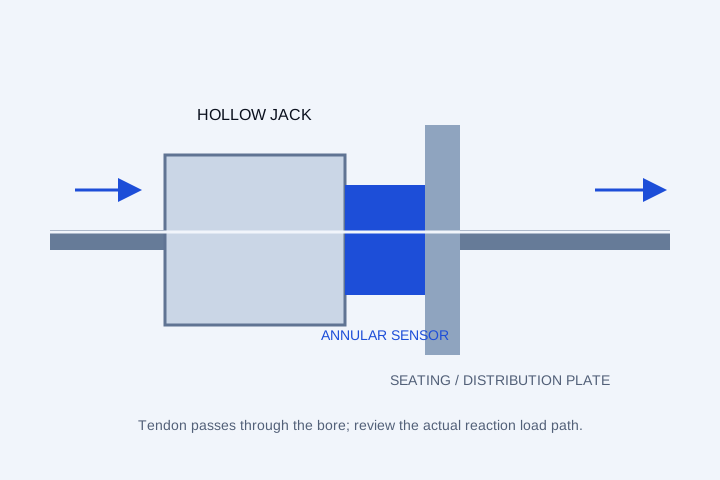
The jack force must pass through the intended sensing path
A hollow tensioning assembly can place an annular sensor in the reaction path while a tendon or threaded bar passes through the centre. Another system may infer force from hydraulic pressure. Define which principle is required; pressure, piston area and measured mechanical force are not interchangeable specification fields.
| Assembly field | Drawing or operating detail required |
|---|---|
| Central bore and tendon | Minimum clearance, bar/strand geometry, sleeves and alignment. |
| Reaction plates / spherical seating | Contact diameters, stiffness, surface finish, flatness and permitted angular accommodation. |
| Force and installation | Working force, peak tensioning force, hold duration, temporary or permanent installation and temperature. |
| Measurement principle | Strain-gauge electrical output or hydraulic pressure-derived force, with the corresponding calibration chain. |
Bridge tendons, wind-turbine anchor bolts and ground anchors have different installation and acceptance requirements. Send the section drawing rather than selecting on maximum kN alone.
Matched distribution plates are an enquiry option. Their dimensions and load transfer need project-specific review; the schematic is not a fabrication drawing.
Send an anchor load-path review →CONFIGURATION AND DOCUMENT REVIEW
Compare the load path and signal before the drawing review
| Configuration reference | Force / use envelope | Signal request | Mechanical and evidence checks | Enquiry |
|---|---|---|---|---|
| TLC-HTL Hollow-anchor tensioning review | 100–2,000kN requested scope | 4–20 mA / 2.0 mV/V bridge | Bore / seating / distribution plate review Identify whether force is inferred from hydraulic pressure or measured by an annular strain-gauge element. Dimensions, accuracy and model datasheet: confirm on the approved configuration. | Request TLC-HTL review → |
Resolve the configuration before the purchase order
Is the hollow sensor hydraulic or strain-gauge based?
Both terms occur in tensioning applications. Establish whether force is derived from hydraulic pressure or measured by an annular strain-gauge element in the reaction path. The hardware and calibration differ.
Can a bore diameter alone select the sensor?
No. Seating flatness, contact area, bore clearance, eccentricity, load direction, plate stiffness and maximum force all affect the assembly.
Carry the interface and evidence into your RFQ
Download the force-selection guide and editable interface worksheet.
Calibration and proof-load scope →Identify which report and accreditation scope the application requires.
Compare enquiry configurations →Filter the geometry, force envelope and signal before requesting a model.
Replacing an existing sensor? Start with the sourced manufacturer reference and document checklist →
CONFIGURATION / INTERFACE / DELIVERY
Send an engineering RFQ with the details intact
Choose the force path, signal and matching accessories. Include the destination so the quotation can confirm the product, calibration, freight and requested delivery term together.
[email protected]Open engineering notes are available in the downloads centre. Approved model STEP, IODD and real calibration reports are supplied against the selected configuration. Price, availability, lead time and warranty terms are confirmed in the formal quote.